Direct answer
Most flame retardant workwear fabric is specified against one hazard and then trusted on the others. A single garment worn at an electrical fault has to hold four at once: the arc, the flame and heat that follow it, the static charge that builds before it, and the mechanical wear of doing the job in it.
AVS-WR-240 is built for that combination. It is an aramid viscose fabric with elastane and an anti-static component — 240±10 g/m², rip-stop, weft stretch — tested to EN 61482-1-2 at arc protection class APC1; tested to NFPA 2112 across heat transfer, flame resistance, heat resistance and the manikin method, pass on all four; EN ISO 11612 A1/A2/B1/C1/F1; EN ISO 11611 Class 1 for molten metal spatter; EN 1149-5 pass for static; mechanical values held after 60 °C washing.
One qualification matters more than the rest, and it is the one buyers get wrong: APC1 is a class under a box test, not a thermal performance value, and it cannot be converted into one. That distinction is set out below, because getting it wrong at tender stage is expensive.
Hazard 1 — Arc: the class, and the scale it is not
EN 61482-1-2 is a box test. A defined test current is applied — 4 kA for APC1, 7 kA for APC2 — and the material is judged on whether it resists break-open and limits heat transfer behind the sample. The output is an arc protection class. AVS-WR-240 sits at APC1.
The other route is the open-arc test, IEC 61482-1-1 or ASTM F1959. That one produces ATPV or ELIM, expressed in cal/cm², and answers a different question: how much incident energy can this material system tolerate before a second-degree burn threshold is predicted behind it.
These are two scales and they do not convert. An APC1 class does not correspond to any cal/cm² figure, and no arithmetic turns one into the other — the test currents, exposure geometry and pass criteria all differ. If your electrical safety programme is written in incident energy terms, you need open-arc data for the construction you will actually wear. Asking a supplier to translate a box-test class into a number is asking for a claim nobody can stand behind.
What APC1 does say is concrete: at its defined arc exposure, this fabric was tested and did not fail its criteria. For a programme written around EN 61482 APC1, that is the document that matters.
On weight, since it is the next question. Within one construction system, adding weight raises the arc rating — mass absorbs energy, and that is the dominant lever, which is why arc-rated ranges move in weight steps. But the rating is still measured, never calculated: same weight with different weave density and break-open behaviour can land a class apart. The genuinely hard direction is the opposite one — a high arc rating out of a light fabric, which is won with aramid content, cover factor and a tight weave rather than with mass.
Hazard 2 — Flame and heat: what “pass” means across three standards
An arc is an ignition source as much as an energy event, so the fabric has to behave after it as well as during it.
Under NFPA 2112, AVS-WR-240 is tested to four methods and passes each: heat transfer by ASTM F2700-2020, flame resistance by ASTM D6413-2022, heat resistance by ASTM F2894-2021, and the manikin method under Clause 8.5. Note the wording — tested to, pass. NFPA 2112 certification belongs to the garment, not the roll, and is issued to whoever assembles and labels it. A fabric datasheet can report results; it cannot certify a garment.
Under EN ISO 11612 the fabric carries A1 and A2 for limited flame spread (ISO 15025:2016), B1 for convective heat (ISO 9151:2016), C1 for radiant heat (ISO 6942:2002), F1 for contact heat (ISO 12127-1:2015) and heat resistance to ISO 17493:2016. Under EN ISO 11611 it holds Class 1 for impact of molten metal spatter (ISO 9150:1988). Read together, those letters describe a fabric that resists ignition, slows heat through three transfer routes and survives molten metal droplets — which is what a maintenance electrician’s day contains.
Hazard 3 — Static: EN 1149-5 and the fibre that carries it
Static is the quiet hazard. A charge that builds on a garment and discharges at the wrong moment is a plausible ignition source in an atmosphere that already holds fuel, and no amount of flame resistance compensates for causing the spark.
AVS-WR-240 passes EN 1149-5:2018. That compliance is carried by the anti-static component in the blend, which is why it is not a finish that washes off and not a detail to be value-engineered out. For antistatic FR fabric used in explosive atmospheres the specification is the pair — flame resistance and dissipative behaviour on the same garment, verified on the same sample.
Hazard 4 — Mechanical: rip-stop is a structure, not a finish
A garment that tears at the sleeve on the first snag has stopped protecting that arm, whatever its certificate says. Mechanical performance decides whether the protection is still in place in month eighteen.
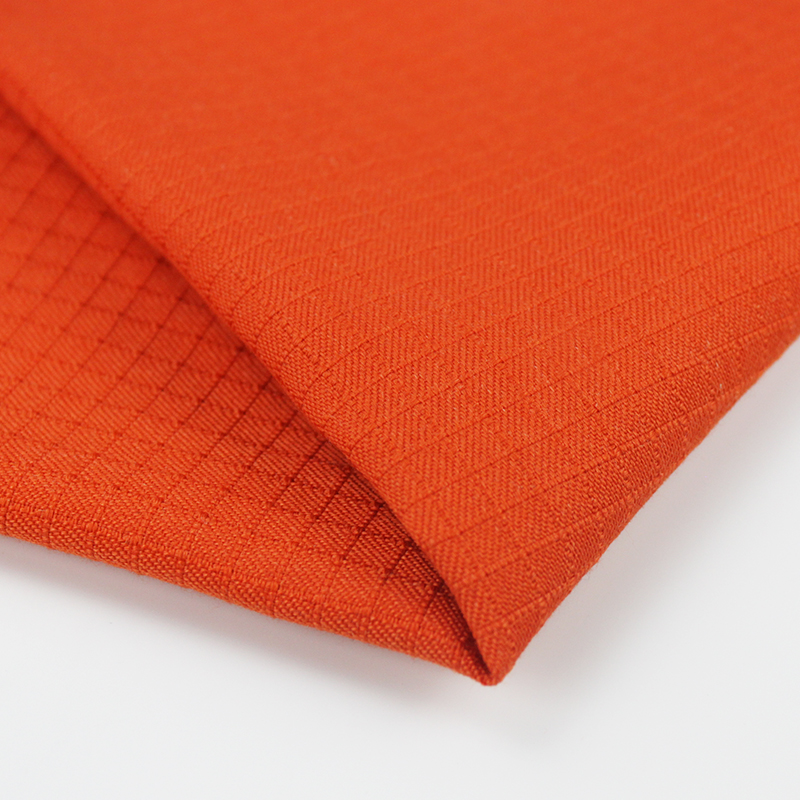
AVS-WR-240 holds tensile strength of ≥800 N warp and ≥650 N weft (ISO 13934-1:2013), tear strength ≥30 N both directions (ISO 13937-2:2000), abrasion ≥40,000 rubs at 12 kPa (ISO 12947-2:2016) and pilling ≥3 grade (ISO 12945-2:2020). The rip-stop grid is the structural half of that story: it stops a tear at the grid line instead of letting it run the length of the panel. That is a weave decision, not a coating, and it is why rip stop FR fabric behaves differently from a plain weave of the same weight.
The requirement nobody writes into the tender: will they wear it?
Protection exists only while the garment is on. A fabric that is heavy, stiff and airless gets removed at the first unsupervised break, and every certificate in the file becomes irrelevant at that moment.
This is where 240 g/m², weft stretch and air permeability do their work. Air permeability is ≥50 mm/s (ISO 9237:1995), which is what keeps a woven barrier wearable through a warm shift. Weft stretch lets the garment move with the wearer instead of fighting them at the shoulder and knee. Dimensional stability is ±3% both directions after washing (ISO 5077:2007), so the fit you specified is the fit that comes back from the laundry. Colour fastness holds at ≥4 grade to water, washing, perspiration and dry rubbing, and ≥3 grade to wet rubbing (ISO 105 series). Care is specified at 60 °C, no bleaching, no tumble drying — those instructions are part of the specification, because a garment washed outside them has no verified data.
Standards at a glance
| Hazard | Standard | Measures | AVS-WR-240 |
|---|---|---|---|
| Arc | EN 61482-1-2 box test | Break-open and heat transfer at a defined current | APC1 |
| Arc, other scale | IEC 61482-1-1 / ASTM F1959 | ATPV or ELIM, in cal/cm² | Not tested — not convertible |
| Flame and heat | NFPA 2112 | Heat transfer, flame, heat resistance, manikin | Tested to, pass on all four |
| Flame and heat | EN ISO 11612 | Flame spread, convective, radiant, contact heat | A1 / A2 / B1 / C1 / F1 |
| Molten metal | EN ISO 11611 | Impact of spatter | Class 1 |
| Static | EN 1149-5 | Electrostatic dissipative behaviour | Pass |
| Mechanical | ISO 13934-1 / 13937-2 / 12947-2 / 12945-2 | Tensile, tear, abrasion, pilling | ≥800/650 N; ≥30 N; ≥40,000 rubs; ≥3 |
| Wearability | ISO 9237 / ISO 5077 | Air permeability, dimensional stability | ≥50 mm/s; ±3% |
Selection and acceptance checklist
| Ask for | Why it decides the outcome | What good looks like |
|---|---|---|
| Which scale your programme uses | Classes and incident energy are different languages | Known before you ask |
| The hazard set, not just the arc | Arc-rated clothing that fails spatter is the wrong garment | Four hazards matched to the fabric |
| Test reports, not logos | Fabric report and garment certificate differ | Dated fabric-level results per standard |
| Mechanical numbers | Tear and abrasion decide service life | Tensile, tear, abrasion, pilling stated |
| Comfort data | Whether it stays on is a safety variable | Air permeability and stretch declared |
| Care and stability | Specifications fail in the laundry | Wash conditions and tolerance stated |
Frequently asked questions
Does APC1 mean the fabric is arc rated to a cal/cm² value?
No. APC1 is a class under EN 61482-1-2, the box test, where the material is tested at a defined arc current — 4 kA for APC1, 7 kA for APC2 — and judged on break-open and heat transfer. The cal/cm² figure comes from the open-arc route instead, IEC 61482-1-1 or ASTM F1959, which reports ATPV or ELIM. Two scales, different test geometry, different criteria, no conversion between them. If your programme is written in incident energy, ask for open-arc data on the exact construction you will wear.
Is AVS-WR-240 NFPA 2112 certified?
What the technical data sheet reports is tested to NFPA 2112, pass, across heat transfer, flame resistance, heat resistance and the manikin method. NFPA 2112 certification is a garment-level matter, issued to the manufacturer that assembles and labels the finished garment. We hold the fabric-level results and will not describe them as a certificate we do not hold.
If the rating has to be measured anyway, why does weight matter?
Because within one construction system more mass raises the arc rating — the main lever, and the reason arc-rated fabrics are offered in weight steps. What weight cannot replace is the test: same weight, different weave and break-open behaviour and you can land a class apart. The hard direction is the opposite one, a high arc rating at low weight, and that comes from aramid content, cover factor and tight weave.
Can one fabric cover arc, flame, static and mechanical at once?
That is the design intent, and each hazard pulls differently. Aramid carries thermal stability and char strength; viscose adds moisture regain and the comfort that keeps the garment on; the anti-static component delivers EN 1149-5; elastane and the rip-stop grid cover movement and tear. The compromise sits in the balance of those decisions, not in dropping a hazard.
Work with us
Mingda Textile has spent four decades on aramid in Shantou, China, with spinning, plying, weaving and finishing in-house. For a multi-hazard fabric that matters, because the trade-offs are structural — blend, weave density and rip-stop grid are settled at the loom.
AVS-WR-240, in brief: aramid viscose fabric with elastane and anti-static component; 240±10 g/m² (about 7.1 oz/yd²); width ≥148 cm; rip-stop with weft stretch; arc protection class APC1 to EN 61482-1-2; NFPA 2112 fabric tested with pass results; EN 11612 A1/A2/B1/C1/F1; EN ISO 11611 Class 1; EN 1149-5 pass; 60 °C wash. It is one arc rated fabric specified for arc flash protection clothing across four hazards, not a catalogue of single-purpose rolls.
Our quality management system is certified to ISO 9001:2015, certificate U25Q2GZ690462R4M, valid to 9 September 2028.
Send us the hazard set for the task and tell us which scale your programme uses. We will confirm exactly which test documents are available for this construction and arrange sample yardage. Availability and lead time are confirmed against your enquiry.