Direct answer
Conventional modacrylic flame retardant yarns owe part of their performance to antimony trioxide, added as a gas-phase synergist. AC402 is spun from Protex-F — Kaneka’s antimony-free modacrylic fibre — so no antimony-based synergist enters the formulation at all. The flame resistance sits in the polymer itself rather than in an additive.
That difference is a sourcing question, not a chemistry debate. Diantimony trioxide (CAS 1309-64-4) carries a harmonised Carc. 2 (H351) classification under EU CLP, appears on ECHA’s rolling assessment plan and on California’s Proposition 65 list, and several US state flame retardant statutes now define a regulated flame retardant chemical to include the synergist. A yarn can therefore pass a vertical flame test and still be stopped by a buyer’s restricted substances list.
Why antimony-free is a procurement question
- Conventional modacrylic FR yarns rely on antimony trioxide as a synergist. It is inexpensive, it works, and it has been standard practice for decades.
- Regulators have started to reach the synergist, not only the flame retardant. New York’s flame retardant law (ECL Article 37, Title 10) defines a regulated chemical to include a synergist to chemicals that resist or inhibit the spread of fire, and California’s AB 2998 uses the same functional definition. New York’s text also treats textiles made from modacrylic fibre without antimony trioxide as a separate case.
- Antimony (CAS 7440-36-0) sits on the Washington CHCC list for children’s products, where annual reporting obligations can apply.
- The useful sourcing question is therefore not whether a yarn passes, but what it passes with. Asked at shipment level, that question is an expensive one.
We do not claim that antimony is banned in apparel. The narrower and verifiable statement is this: several European and US instruments now capture flame retardant synergists, and a growing number of buyer restricted substances lists apply limits accordingly. For that reason an antimony-free formulation has moved from an environmental bonus to a procurement threshold in a number of programmes.
Where the regulatory pressure comes from
| Instrument | What it provides | What it means for sourcing |
|---|---|---|
| EU CLP | Diantimony trioxide (CAS 1309-64-4) has a harmonised Carc. 2 (H351) classification | Restricted substances lists commonly reference this classification directly |
| ECHA CoRAP | Diantimony trioxide is on the EU rolling assessment plan | Regulatory attention is increasing rather than settling |
| California Proposition 65 | Diantimony trioxide is listed as a carcinogen | Sales into California may require exposure assessment and possibly a warning |
| New York ECL Article 37, Title 10 | The definition of a regulated organohalogen flame retardant chemical includes substances acting as a synergist; modacrylic textiles made without antimony trioxide are treated separately | US legislators explicitly distinguish antimony-free modacrylic from the antimony-system version |
| California AB 2998 (B&P Code 19100 / 19101) | Regulated flame retardant chemicals include those whose function is to act as a synergist; 1,000 ppm limit for covered product categories | Synergists, including antimony-based ones, fall inside the definition |
| Washington CHCC (WAC 173-334-130) | Antimony (CAS 7440-36-0) is on the chemicals of high concern to children reporting list | Children’s product categories can carry annual reporting duties |
AC402 specification
| Item | Data |
|---|---|
| Model | AC402 |
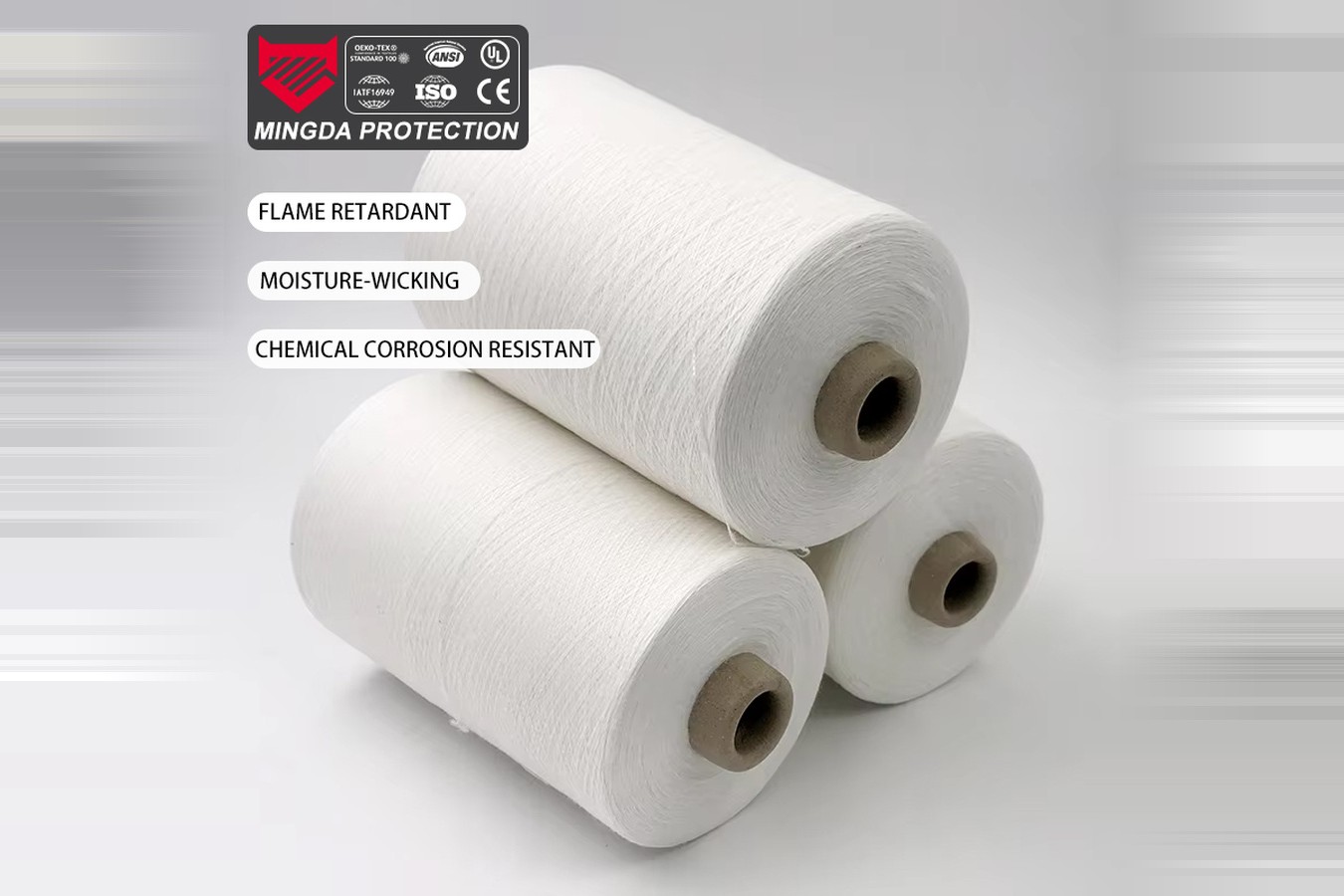
| Fibre | Protex-F antimony-free modacrylic (Kaneka), blended with cotton or viscose |
| Composition | Modacrylic / cotton / viscose — 70/30, 60/40, 55/45 |
| Yarn count | Ne 8s–50s, including Ne 40/2 |
| Construction | Core-spun, Siro-spun, staple yarn |
| Twist | Regular standard or customised, S/Z |
| Colour | Raw white |
| Packing | Carton |
| Performance | Inherent flame retardant, antimony-free, no melt, no drip, high tenacity, moisture-absorbent |
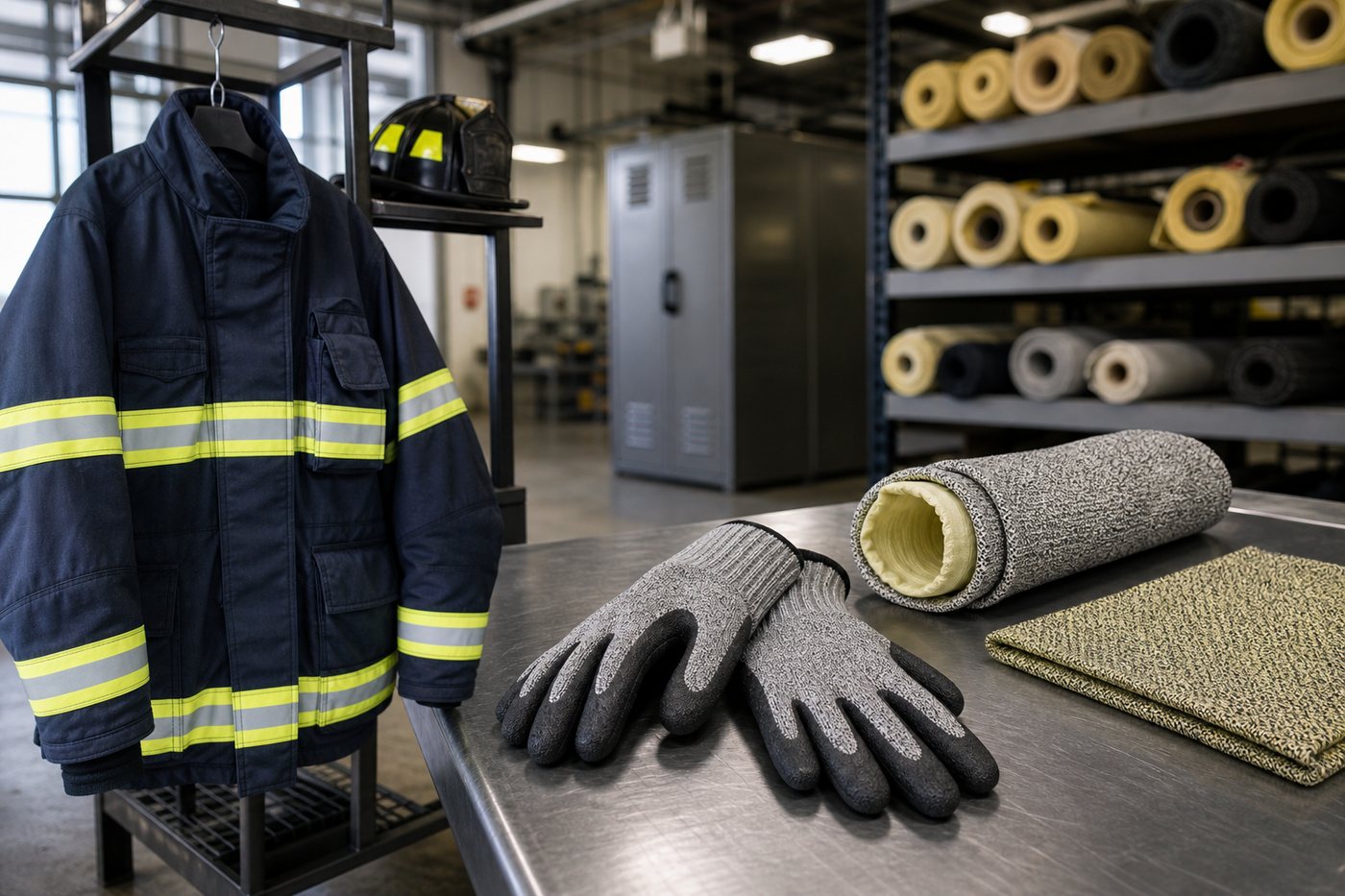
| Applications | FR fabrics, FR gloves and glove liners, welding protection, industrial knitwear, hand knitting |
| Minimum order | 300 kg |
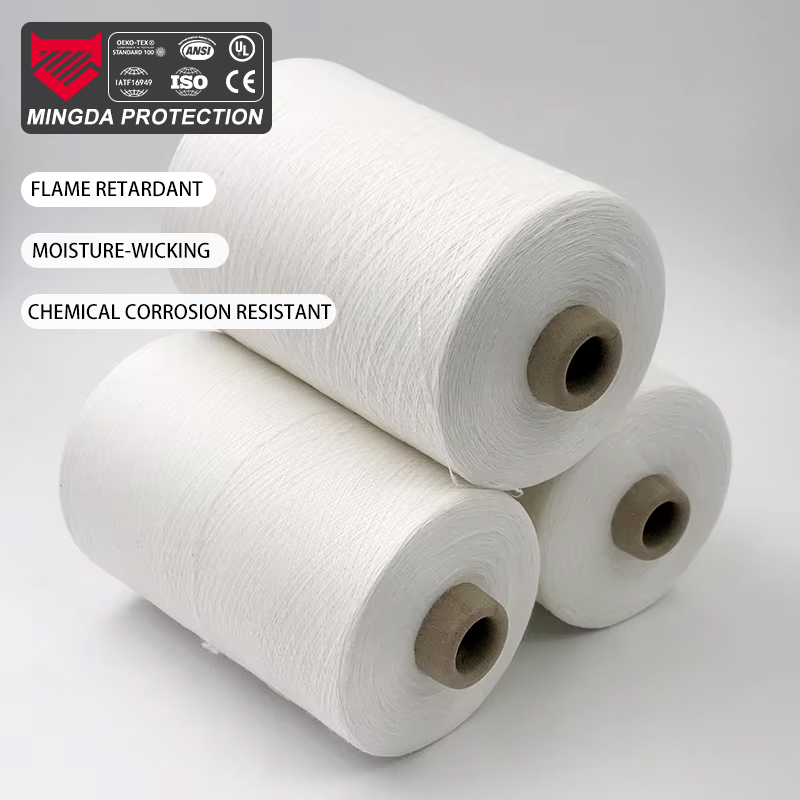
How AC402 compares with conventional modacrylic FR yarns
| Dimension | AC402 (Protex-F) | Conventional antimony-system modacrylic FR yarn |
|---|---|---|
| Flame retardant mechanism | Halogen copolymer, inherently flame retardant; no antimony synergist | Halogen copolymer plus an antimony trioxide synergist |
| Antimony content | None | Reported in published patent literature at levels approaching ten percent by weight in some conventional types |
| Buyer RSL exposure | No antimony-based synergist to declare | The synergist must be declared and may be limited |
| No melt, no drip | Yes — the fibre chars and self-extinguishes | Yes |
| Inherent flame retardant (does not wash out) | Yes | Yes |
| Fit with strict EU and US programmes | Removes the antimony variable at fibre level | Requires case-by-case RSL review |
Two evidence boundaries we hold to. First, the antimony content figure for conventional types comes from published patent literature and third-party technical review, not from a supplier datasheet, and we do not publish antimony figures for other manufacturers’ current products. Second, the antimony-system types are not defective — the Protex grades that use antimony trioxide (the C and M types) remain reference modacrylics for arc and flash fire protection, and they are specified successfully every day. Protex-F is simply the route that removes one variable from the compliance chain, and antimony-free is where the fibre market is heading.
Decision guide: how to specify
- Start from the hazard profile, not from the fibre. Molten metal splash, electric arc, flash fire and radiant heat each load a fabric differently, and the fibre choice follows.
- Fix the standard and the certification route before the material. European programmes route through EN ISO 11612 and EN ISO 20471; US arc programmes route through ASTM F1506 and NFPA 70E.
- Decide the fibre family, then the formulation. If the programme carries a restricted substances list that names antimony trioxide, an antimony-free fibre removes the question before it is asked.
- Fix blend ratio, yarn count and construction together. Modacrylic blends with cotton or viscose behave differently at the needle and after finishing, so the blend is a machine decision as much as a performance one.
- Ask the fibre supplier for a raw-material-level antimony declaration. An input declaration is cheaper and faster than a finished-goods test, and it survives a customer audit.
- Validate on your own machine and your own finishing route before committing to volume. A sample tells you more about a yarn than any datasheet will.
Frequently asked questions
Is antimony banned in flame retardant textiles?
No. There is no general ban on antimony in apparel. What has changed is narrower and more practical: diantimony trioxide carries a harmonised Carc. 2 (H351) classification under EU CLP, it is listed under California Proposition 65, and several US state flame retardant statutes now define a regulated chemical to include the synergist as well as the flame retardant itself. In practice this reaches buyers through restricted substances lists rather than through prohibition.
What does no melt, no drip mean in practice?
When modacrylic is exposed to flame it chars and self-extinguishes instead of melting and flowing. That matters most where molten polymer contact is the dominant injury mechanism, which is why welding and metalworking programmes specify it. A charred surface that stays in place is a different hazard from molten polymer on skin.
Can the flame retardancy wash out, or drift between lots?
The flame retardant chemistry is part of the polymer rather than a finish applied to the surface, so it cannot be washed away and it does not need to be reapplied. Two yarns produced to the same specification behave the same way after laundering, because nothing was added on top of the fibre to begin with.
Which certifications apply to AC402?
Two, both verifiable and both current. OEKO-TEX STANDARD 100 for yarn — certificate HK005 167918, product class II for articles with direct skin contact, valid to 31 July 2027. ISO 9001:2015 quality management system — certificate U25Q2GZ690462R4M, valid to 9 September 2028. These are yarn-level and system-level certificates. Garment-level certification such as EN 469, NFPA 1971 or EN ISO 11612 belongs to the garment manufacturer and is not claimed here.
Work with us
Mingda Textile is a vertically integrated spinner and weaver of aramid and modacrylic yarns and fabrics, based in Shantou, China, with four decades in protective textile manufacturing. Spinning, plying, weaving and finishing run in-house, which is what allows a yarn specification to be engineered to the hazard rather than picked from a catalogue: composition, count, construction and twist are developed against your target fabric weight and your own finishing route.
Send us your hazard profile, your target standard, and your target count and blend. We will come back with a construction proposal, the matching sample and the available test routes.
Website: https://www.mingdaprotect.com
Free samples: 1–2 cones, 0.3–0.5 kg per cone. Trial orders from 300 kg. Tell us your target market and we will send the matching yarn data.