Gauge-13 HPPE knit liner
The liner is knitted from high-tenacity UHMWPE (HPPE) yarn at 13 gauge — a fine, dense knit that puts the cut-resistant fibre where the edge meets the hand without the bulk of a heavier glove.
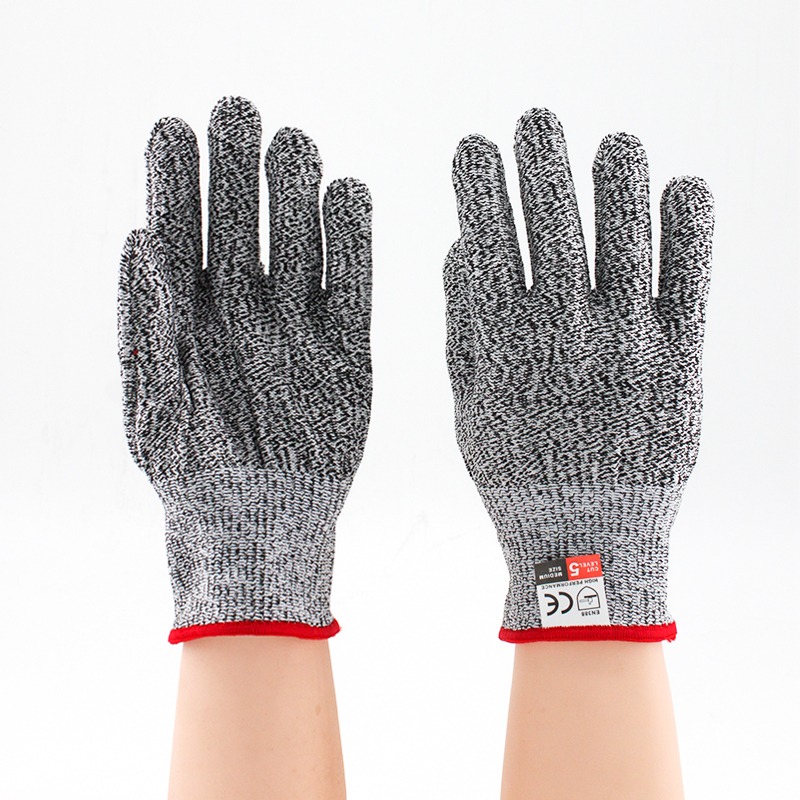
HPPE knit · PU coated · Latex coated · Para-aramid (aramid 1414) heat-resistant · Gauge 7 to 13 · EN 388 and ANSI/ISEA 105
Our cut-resistant glove family covers the whole hand-protection brief: fine-gauge HPPE knit liners, PU and latex coated gloves for grip and abrasion, and para-aramid gloves that stay resistant at high temperature as well as against the blade. Part of the HAILIDUN protective line by Shantou Mingda Textile.
Five points
Six points, and the engineering reason behind each one.
The liner is knitted from high-tenacity UHMWPE (HPPE) yarn at 13 gauge — a fine, dense knit that puts the cut-resistant fibre where the edge meets the hand without the bulk of a heavier glove.
The palm and fingers are dipped in nitrile, so the surface resists oil and abrasion and keeps its grip on wet or oily parts, while the back of the hand stays bare knit and the glove keeps breathing.
Cut resistance comes from the fibre, not from the coating: UHMWPE carries the cut and abrasion load while the nitrile adds grip and surface wear resistance. The glove is specified to EN 388 and ANSI/ISEA 105, and the level delivered is confirmed against the test report for the production lot.
A 13-gauge liner is thin enough to pick up, hold and inspect small parts without taking the glove off, which is what decides whether a safety glove is actually worn through a shift.
We spin the HPPE and para-aramid yarn and knit the liner in our own plant in Shantou, Guangdong, so the fibre content and the gauge are controlled at the source rather than in a bought-in glove.
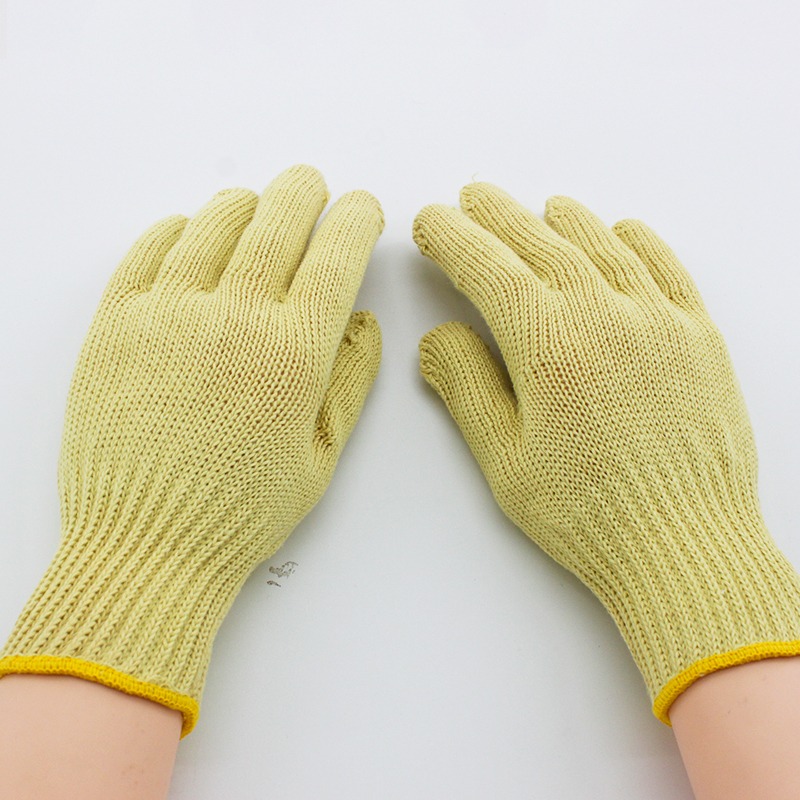
Para-aramid (aramid 1414) gloves in the same range cover the work where a sharp edge and a hot surface arrive together — foundry and casting handling, hot glass and metal press work, welding support and heat-treatment lines. The fibre is inherently flame resistant and does not melt or drip, so the glove keeps protecting at temperatures a polyethylene liner cannot take; it also holds a far higher tenacity than steel by weight, so the cut protection stands up on its own rather than relying on a coating. Our aramid glove models run from A2 to A6 on the ANSI/ISEA 105 scale, in 7-gauge and 10-gauge builds, with steel-wire and glass-fibre blends where the cut load is highest.
Technical data
What the glove is made of, taken from our product index for model GS-48.
| Model | GS-48 |
|---|---|
| Composition | UHMWPE (HPPE) liner with a nitrile palm coating |
| Liner structure | Knitted liner, 13 gauge |
| Coating | Nitrile, palm-dipped |
| Cut level | ANSI/ISEA 105 A5 |
| Weight per pair | On request — set with the order |
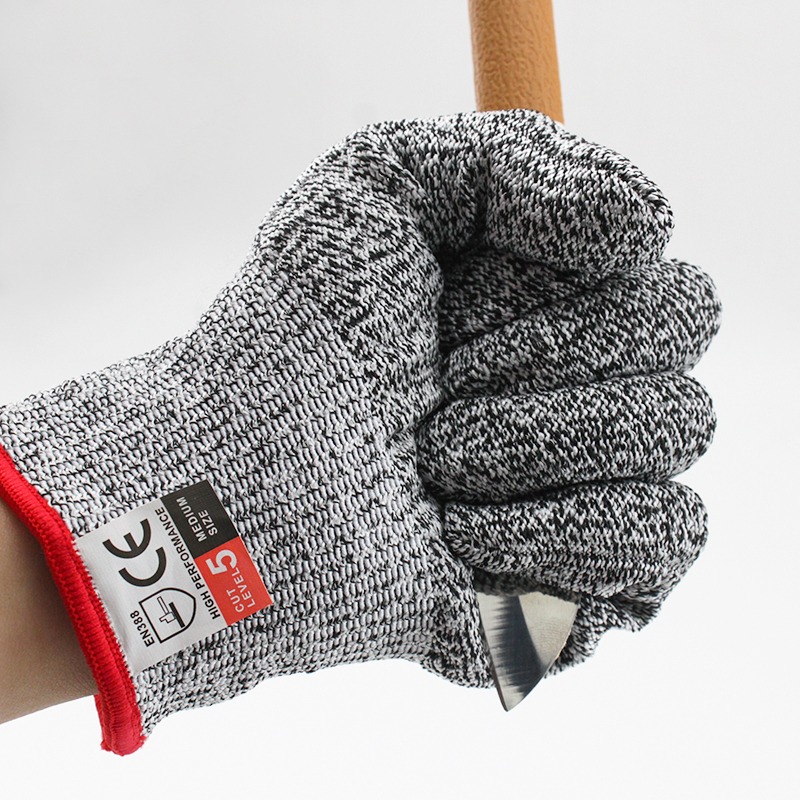
Composition, liner structure and gauge are the recorded values for GS-48 in our product index. Weight per pair is set per order and is confirmed with the specification — tell us the sizes and the lengths your programme runs.
The range
Twenty glove models from our current glove catalogue. Gauge, reference size, weight and cut level are the catalogue values for each model; the aramid group is the heat-resistant side of the range.
| Item no. | Gauge | Ref. size | Weight | Cut level | Material | Feature |
|---|---|---|---|---|---|---|
| GS-52 | 7 | 9/L | 33.4 g/pc | A2 | Para-aramid | Flame and high-temperature resistant |
| GS-36 | 7 | 9/L | 36.6 g/pc | A3 | Para-aramid | Flame and high-temperature resistant |
| GS-37 | 7 | 9/L | 37.2 g/pc | A4 | Para-aramid / glass fibre / polyester | Flame, high-temperature and cut resistant |
| GS-35 | 7 | 9/L | 34.2 g/pc | A5 | Para-aramid / steel wire | Flame, high-temperature and cut resistant |
| W70502-6 | 7 | 9/L | 40 g/pc | A6 | Para-aramid / steel wire | Flame, high-temperature and cut resistant |
| GS-58 | 7 | 9/L | 75 g/pc | A5 | Para-aramid / steel wire / glass fibre / polyester / spandex | Cut resistant, thermal insulation |
| GS-38 / GS-40 | 10 | 9/L | 29.1 g/pc | A2 | Para-aramid | Flame and high-temperature resistant |
| GS-41 | 10 | 9/L | 28.9 g/pc | A3 | Para-aramid / glass fibre / polyester | High-temperature and cut resistant |
| GS-33 | 10 | 9/L | 61 g/pc | A3 | Para-aramid / glass fibre / polyester | Thermal insulation, slip resistant |
| GS-39 | 10 | 9/L | 29.3 g/pc | A4 | Para-aramid / steel wire | Flame, high-temperature and cut resistant |
| GS-87 | 10 | 9/L | 62 g/pc | A5 | Para-aramid / polyester / steel wire / glass fibre / spandex | Cut resistant, thermal insulation |
| GS-85 | 10 | 9/L | 33 g/pc | A2 | Para-aramid | Cut resistant, thermal insulation, slip resistant |
| W00401-4 | 10 | 9/L | 34 g/pc | A4 | Para-aramid / polyester / steel wire / spandex | Cut resistant |
| F01302-2 | 10 | 9/L | 51 g/pc | A2 | Para-aramid | Cut resistant, thermal insulation |
| GS-32 | 10 | 9/L | 65.5 g/pc | A2 | Para-aramid | Thermal insulation, slip resistant |
| GS-30Latex | 10 | 9/L | 55.2 g/pc | A4 | Para-aramid / polyester / glass fibre / steel wire | Thermal insulation, slip resistant, cut resistant |
| GS-83 | 7+7 | 9/L | 82 g/pc | A2 | Para-aramid / cotton, double layer | Thermal insulation level 3 |
| DKP01 | 10+7 | 9/L | 99 g/pc | A2 | Para-aramid / cotton, double layer | Thermal insulation level 2 |
| GS-106 | 7+7 | 9/L | 86 g/pc | B | Meta-aramid / cotton, double layer | Thermal insulation level 2 |
| GS-82 | 13 | 9/L | 58 g/pc | A4 | Para-aramid / glass fibre / spandex | Cut resistant, arc resistance level 2 |
Gauge, reference size, weight and cut level are the values our current glove catalogue carries for each model, and the cut level is printed on the ANSI/ISEA 105 scale the catalogue records it against. Sizes beyond the reference size, glove lengths and colours are set with the order. Minimum order quantities and prices are quoted with the offer rather than printed on this page; ask our sales team for the current schedule.
Ratings explained
Two standards do the work in a cut-resistant glove, and they are written differently. EN 388 is the European standard for mechanical risks: abrasion, cut, tear and puncture are measured and the result is printed as four digits, with a letter added for the ISO 13997 cut test introduced in the 2016 edition — a code such as 4X42F. ANSI/ISEA 105 is the American standard: cut resistance is reported as a level from A1 to A9, set by the load the blade needs to cut through the sample.
The two scales are not interchangeable. They use different blades, loads and methods, so a glove is tested against the standard the buyer's market uses, and a level is only meaningful with the standard and the edition named beside it. What both scales agree on is the principle: read the level against the work the glove is bought for, not as a number on its own.
| What it decides | EN 388 | ANSI/ISEA 105 |
|---|---|---|
| Scope | Mechanical risks to the hand: abrasion, cut, tear, puncture | Hand protection: cut, abrasion, puncture and impact levels |
| How cut resistance is measured | Coupe test (rotating blade under load) in the 2003 edition; ISO 13997 TDM test from the 2016 edition | TDM test; the result is the load in grams needed to cut through the sample |
| How the result is written | Four digits — abrasion, cut, tear, puncture — plus a letter A–F for the ISO 13997 cut result | A cut level from A1 (lowest) to A9 (highest) |
| Where it is used | Europe, and the markets that follow EN standards | United States, and the markets that follow ANSI/ISEA |
The two cut standards compared
| Standard | Cut level | Load the level stands for |
|---|---|---|
| EN 388:2016 (ISO 13997) | A | 2 N and above |
| EN 388:2016 (ISO 13997) | B | 5 N and above |
| EN 388:2016 (ISO 13997) | C | 10 N and above |
| EN 388:2016 (ISO 13997) | D | 15 N and above |
| EN 388:2016 (ISO 13997) | E | 22 N and above |
| EN 388:2016 (ISO 13997) | F | 30 N and above |
| EN 388:2003 (coupe test) | 1 – 5 | The older five-level coupe scale, still quoted on older listings |
| ANSI/ISEA 105-2016 | A1 – A2 | 200 – 999 g |
| ANSI/ISEA 105-2016 | A3 – A4 | 1,000 – 2,199 g |
| ANSI/ISEA 105-2016 | A5 – A6 | 2,200 – 3,999 g |
| ANSI/ISEA 105-2016 | A7 – A9 | 4,000 g and above |
Cut levels as each standard defines them
| Level band | Typical work | What decides it |
|---|---|---|
| A1 – A2 | Light handling: order picking and packing, assembly of finished parts, handling with occasional light burrs | The occasional sharp edge; dexterity matters more than resistance |
| A3 – A4 | General handling of sharp-edged parts: glass and panel handling, sheet-metal trimming, maintenance | A continuous sharp edge in the hand, so the fibre has to carry the load |
| A5 – A6 | Heavy handling: metal stamping, plate and profile work, demolition and recycling | Heavier cut load plus abrasion, which is where HPPE and steel or glass blends are used |
| A7 – A9 | Extreme cut exposure: heavy plate, blade-adjacent and specialist industrial handling | The highest cut load, normally bought against a specific risk assessment |
Which level for which work
In service
Cut-resistant gloves are specified where the hand meets a sharp edge in normal production — not in an accident, but in the work that happens every shift. The HPPE group covers the mechanical side of that; the aramid group covers the work where a sharp edge and a hot surface arrive together.
Handling sheet, blanks, profiles and pressed parts where the edge is the hazard and abrasion comes with it.
Moving and fitting glass, panels and laminates: a continuous sharp edge, and a grip that must hold when the surface is wet.
Line assembly, part picking and workshop maintenance, where a thin glove has to stay on for the whole job.
Cartons, strapping, banding and cutters — the everyday cut risks of receiving, picking and dispatch.
The para-aramid gloves are specified where the work is hot as well as sharp: handling castings and hot pressings, hot glass, heat-treated parts and welding support. The fibre does not melt or drip, so the glove holds its protection at surface temperatures a polyethylene liner cannot take, and it keeps a high cut load of its own rather than depending on a dip.
The aramid range carries models with arc-resistance and flame-resistance ratings for electrical and utility work, where a melting glove is the failure mode that matters most.
This glove is made to conform to the standards listed below, and the level is confirmed against the test report for the production lot. Where a certificate for a specific standard is required, we arrange testing to the customer's requirement.
Test reports are available from our sales team on request, and certificate copies are issued with the sales documents for your order.
A4 and A6 are levels on the ANSI/ISEA 105 cut scale, and the difference is the load the blade needs to cut through the glove: A4 starts at 1,500 g and A6 at 3,000 g, so an A6 glove resists roughly twice the cut load of an A4. In practice that shows up as how long the glove keeps protecting while a sharp edge is dragged across it — A4 for glass, panel and general sharp-part handling, A6 where edges are heavier and the exposure is continuous, such as metal stamping. A higher level usually means a heavier or more blended liner, so the choice is made against the risk assessment rather than simply taking the highest number.
They do not convert directly. EN 388 reports a cut result as a letter from A to F using the ISO 13997 method in its 2016 edition, and ANSI/ISEA 105 reports a level from A1 to A9 using its own TDM test; the blades, loads and procedures differ, so a glove has to be tested against the standard your market uses. EN 388 also prints four digits for abrasion, cut, tear and puncture, while ANSI/ISEA 105 is organised around the cut level plus abrasion, puncture and impact results. Ask for the test report and read the standard and edition it names.
The four digits are abrasion, cut, tear and puncture, in that order, each on a scale from 1 (or 0 if it fails) upward, and a letter after them reports the ISO 13997 cut result of the 2016 edition. A marking such as 4X42F therefore means abrasion level 4, the coupe cut test not performed or not applicable, tear level 4, puncture level 2 and an ISO 13997 cut result of F. Reading a marking this way tells you which tests a glove was actually put through before you read the numbers.
No — cut resistance comes from the knit liner and the fibre in it, not from the coating. What the nitrile palm dip adds is grip and surface abrasion resistance, and it helps on oily or wet parts where a bare knit would slip. This is why we state the liner composition and the gauge alongside the coating: two gloves with the same coating and different liners have very different cut performance.
The liner and the dip are built for industrial service, so the glove can be cleaned — but laundering performance depends on the coating and the cleaning method, and we do not publish a wash-cycle figure without test data for the specific lot. Tell us your laundry or cleaning process and we will confirm what the glove in your specification can take.
Sizes, glove lengths and weight per pair are set with the order, so tell us the size ladder your programme runs and we will confirm the specification against it. This is the reason the size table on this page shows the fields our records leave open rather than a generic ladder: the glove is made to order, and the confirmed size data is issued with the quotation.
The materials are selected and tested for harmful substances — the range is covered by OEKO-TEX® STANDARD 100, which is the test for harmful substances in textiles. Whether a specific glove may be used in contact with food depends on the construction and the local rule that applies to food-contact articles, so tell us the application and we will confirm the construction that fits it.
Yes. The same UHMWPE (HPPE) and aramid fibre systems go into the cut-resistant fabric we weave, into arm sleeves and aprons in the HAILIDUN protective line, and into the reinforcement fabric we supply to hose makers. If your programme needs a cut-resistant layer rather than a glove, tell us the application and we will match the fibre and the structure to it.
Gauge is the number of knitted courses per inch in the liner, and it works in the opposite direction to bulk. A 13-gauge liner is a finer, denser knit that puts more fibre where the edge meets the hand while staying thin enough to feel a small part; a 7-gauge liner is a coarser, heavier knit used where the cut load and the thermal duty are higher. Both are in the range table on this page: the 13-gauge builds are the fine-duty liners and the 7-gauge and double-layer builds are the heavier and insulated gloves. Gauge does not set the cut level on its own — the fibre and its weight do — so read the gauge beside the cut level and the composition rather than instead of them.
Both are dips over the same knit liner, and neither changes the cut level, which is carried by the fibre. The coating decides grip and surface wear. A PU dip is thinner, so it keeps more touch sensitivity and is the dip chosen where small parts have to be picked and inspected. A nitrile dip is heavier and more resistant to oil and to surface abrasion, so it is chosen where the parts are oily or wet and the coating itself has to last. Latex builds are used where grip on a dry, smooth surface matters most. Tell us the part, the surface condition and how long the glove has to stay on the hand, and we will confirm the dip that fits.
Choose on whether heat is part of the hazard. A UHMWPE (HPPE) liner is the light and comfortable option: it gives a high cut level at a low weight, which is why it is the liner in our fine-gauge gloves, and it is not a flame-resistant functional fibre — it melts rather than charring, so it is not specified where heat or molten metal is in the risk assessment. A para-aramid liner is chosen where a sharp edge and a hot surface arrive together: the fibre does not melt or drip, so the glove keeps protecting at temperatures a polyethylene liner cannot take, and it keeps a high cut load of its own rather than relying on the coating. Our aramid glove models run from A2 to A6 on the ANSI/ISEA 105 scale.
Tell us the application, the required weight and the standard you need to meet. Our technical team will come back with a matching fabric, the spec sheet and a quotation.